


Cart
Your shopping cart is empty!
It's not too late to fix it :)
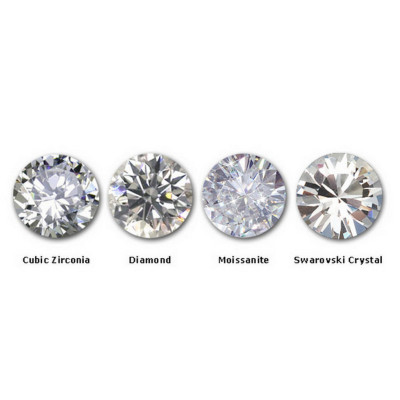
Many connoisseurs of jewelry probably already know firsthand how cubic zirconia differs from zirconium. But not everyone can easily tell the difference between laboratory-grown diamonds.
Cubic zirconia or zirconium, zirconium isdioxide, zirconium silicate, therefore, in the territory of Western countries, the mineral is also known under a different name. Cubic zirconia, or cubic zirconia, is the second name for zirconium in Europe.
Natural stones zircons and the appearance of their analogs, cubic zirconia and zirconia, are shrouded in legends, and this is the story that has been preserved since the existence of the USSR about the birth of artificial precious stones. During the Cold War, the United States and the USSR competed with each other. Specialists from the USA and the USSR fought for the primacy not only in the field of space exploration, but also for the invention of a gem that could be actively used in industrial activities. Of course, in the USSR, at any cost, they tried to get ahead of the Americans in this difficult task. Scientists at the Physics Institute of the Academy of Sciences (FIAN) had to invent a zirconium stone in the name and in spite of.
Although there is another opinion, because zirconia - it's not quite the development of Soviet scientists and a German chemist M. Klaproth. In 1789, he introduced the world to a new artificial gemstone after a long analysis of a natural gem known as zircon. Thus, long before Soviet scientists, work was underway to remove a stone with a diamond structure.
Why did the name zirconium cube catch on? The reason for this is the cubic crystal lattice of zirconium dioxide. Cubic zirconias are artificially grown gemstones, they are also zirconia, but this name is used only in the territory of post-Soviet countries. Cubic zirconia and zirconium - are the same in structure, but fianit name contains the abbreviation FIAN to connoisseurs of gemstones artificial knew where to look for information about the appearance of the stone in the countries belonging to the Soviet Union. Therefore, zirconium stone in jewelry is found in rings and bracelets of American production, while cubic zirconias are produced by domestic companies. Although zirconium cubic zirconia and - the sameAmerican zirconium - agem of introduced from the United States, is more valuable than domestic counterparts, and the reason for that is the brilliant shine. Perhaps this is the only difference between zirconium and cubic zirconia, and why some jewelry manufacturers may prefer zirconium over cubic zirconia.
Since we are talking about precious stones, they must be properly cared for in order to maintain their natural shine. It is enough to wipe thefrom time to time in stones with a soft cloth order to zirconium zirconia clean their cubic from dust. In addition to soft tissue, they also use a solution of soap with the addition of ammonia or ammonia.
Zircon - it's natural gems. Zircon is a stone used in healing, because it has magical properties, the ancient peoples believed, and used it to accumulate positive energy, for example. Zirconium is not natural, but an artificial stone. Zirconium or cubic zirconia - which is more expensive? Zirconium will cost a higher price than cubic zirconia, but cubic zirconias are more affordable and can be used to make amazing jewelry in different price categories. On the website of the Golden Silver jewelry company, you can find a bracelet with inlays of gold and cubic zirconia, a silver ring with cubic zirconiacubic and a ring with zirconia.
Zircon is a mineral of natural origin with a density of 4.6–4.7 g / cm³ and a hardness according to the MOOC mineralogical scale of 6–8. Thanks to the index, hardness you can understand how quickly it scratches and loses its natural shine. On the MEPC scale, a 10 is found in diamond, while a 1 gives off talc. This is probably why zircon is sometimes called the younger brother of diamond in the East.
It is interesting that there are different types of zircon. Stones that are pale pink, bright red and even brown should be looked for under the name hyacinth. Jargon or jargon are called stones of a bright yellow color, while blue is already inherent in the so-called starlites.
The color of zircon changes due to the presence of various impurities, including iron, calcium, aluminum, hafnium. Therefore, there are stones of different colors. As for the peculiarities of obtaining stones of different colors, hyacinth, which lends itself to heat treatment, changes its color to blue. And by heating the stones to a certain temperature, you can change their color.
Where is such a valuable material obtained? Zircon is mined in Thailand, Sri Lanka, the USA, Canada, Australia, Norway, and Russia. It is widely used for making fire resistant materials. Zircon has also been used in jewelry to create uniquely beautiful jewelry, but it certainly cannot compare with the durability of a diamond. Despite the beauty of zircon, cubic zirconia or zirconium began to squeeze it out of the jewelry market. You can meet zircon not in modern jewelry models, but, most likely, in old jewelry that has been well looked after, so you can still enjoy the beauty of a diamond shine.
Is it possible to distinguish cubic zirconia or cubic zirconium from natural zircon? Of course you can. First of all, you need to pay attention to the structure. Natural transparent stones are rare, but if they come across a connoisseur of jewelry, the products will be transparent as a tear. If, when observing a stone, just such a feeling is created, then the owner of the jewelry is dealing with cubic zirconia. Natural stone is distinguished by the presence of mineral inclusions.
To distinguish cubic zirconia from natural stone, you need to pay attention to its weight. Cubic zirconia is slightly heavier than natural stone, despite the fact that the stones can be of the same size. The reason for this is the difference in density, since the density of cubic zirconia is 6.5-10 g / cm3. No mysticism, just a difference in density. And these are, perhaps, those important criteria for distinguishing between cubic zirconia and zircon.
It is difficult to establish the radioactivity of a natural stone on your own without a device that is specially used to measure the level of radiation. But you should know that a little uranium can be found in the composition of zircon, therefore it is considered radioactive, while cubic zirconia is not radioactive at all.
When choosing jewelry, rings, bracelets, earrings, for a private collection of jewelry or for a gift, many are guided by the price of the product and the design. Indeed, the stylistic decision is an important selection criterion, since jewelry not only cheers up, instills confidence, but also complements a casual or evening bow.
Despite the fact that many women will always opt for only natural stones, in the case of zircon, things are not so simple. Sometimes women still need to make a choice in favor of artificial stones, and here's why.
When answering a question, artificial stones cubic zirconia and zirconium - what's the difference,immediately comes to mind is a brilliant shine that will have cubic zirconia more pronounced than in the LPI, then what to do with counterfeit artificial stone? Although cubic and zirconia, zirconium were developed by analyzing zircon to create a stronger and less radioactive artificial stone, cubicandare alternatively zirconia, zirconium counterfeited to reduce the price of the product. But fakes can be seen with the naked eye, since they are noticeably different in workmanship.
Why is it important to distinguish between cubic zirconia and diamonds? Since cubic zirconias have a brilliant shine, some connoisseurs of jewelry who have not yet learned to distinguish different precious stones from each other, and to distinguish fakes, can purchase for a high price not a diamond jewelry, but cubic zirconia or its fake. Therefore, you can always ask for certificates and other proof of the authenticity of the stone.
And the last thing that is important to say about cubic zirconias and zircons. Zircons are natural stones that could have been used in rituals in ancient times, as they had some magical properties. Therefore, wearing zircon as a protective amulet was not surprising for the ancient peoples. Cubic zirconias, which are also called empty vessels because they lack inclusions, do not have the same strength as zircons. But they can be filled with the necessary content at the time of purchase or wearing, therefore cubic and zirconia, zirconium can bring good luck if it is charged by the owner as a stone that brings this good luck.